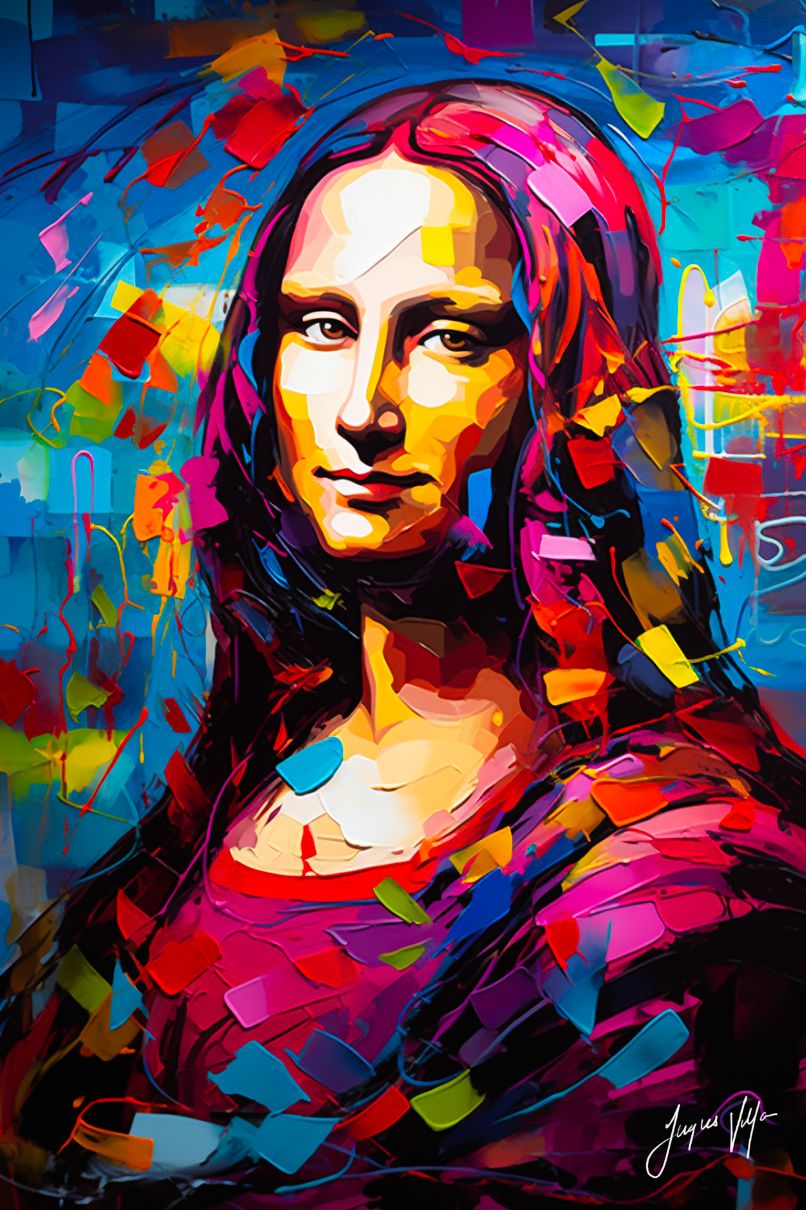
Mona Lisa, Liberated by Graffiti Art Canvas Print
SKU C-MLGRA002
R1 999.00
Canvas Size
Frame Thickness
Please choose
Five centuries contained. One stroke of graffiti set her free
1
Save this product for later
Have questions?
Mona Lisa, Liberated by Graffiti Art Canvas Print
Product Details
The Work
The face is unmistakable. High-contrast light falls across the forehead and cheekbone in warm yellow-white, with deep magenta pressing into the shadows beneath. Her expression carries exactly the composure Leonardo gave her five centuries ago, and nothing about that has changed. What has changed is everything surrounding it. Her hair moves in rivers of electric colour, red bleeding into blue into pink into yellow, rendered in thick, directional impasto strokes that feel gestural and immediate. Behind her, the background fragments into loose colour blocks and fluid linear marks in teal, cobalt, red, and yellow, the visual language of a city wall rather than a gallery. The composition reads as two things simultaneously: a portrait rendered with total precision, and a background that has decided to be completely free.
The Inspiration
Leonardo painted her in sfumato, soft atmospheric edges that dissolved form into feeling. This version takes the opposite approach. Where his technique pulled everything inward into quiet, this one pushes everything outward into colour and movement. The liberation by graffiti was a deliberate choice, not a disruption of the original but a completion of it. For five centuries she sat behind glass in a controlled environment, seen by millions but reachable by none. Street art has always belonged to everyone. Placing her in that visual language gives her back to the public, which is where art was always meant to live.
What It Carries
There is something quietly radical about this piece. It doesn't ask permission to reimagine the most protected image in art history. It simply does it, with confidence and without apology. What stays with you is the tension between the face, composed and classical and entirely certain of itself, and the world around it, free and electric and moving in every direction at once. That tension is the argument of the liberation: that great art doesn't need protection. It needs to be set loose.
Living With It
The palette spans electric blue, cobalt, magenta, red, yellow, and warm white, giving it genuine range across interior schemes. It holds in contemporary, eclectic, and urban-influenced spaces without difficulty. In a neutral room it becomes the entire colour story. In a space that already has colour it adds energy rather than competing. At A0 the face reaches near life-size scale, which changes the dynamic considerably. This is a piece for walls with confidence, hallways that need a statement, living rooms where conversation is the point, and creative spaces that understand that art is not meant to be quiet.
Who It's For
This is for the person who loves art and has never been convinced it should be precious about itself. If you understand that the best things are meant to be shared, Mona Lisa, Liberated by Graffiti already belongs on your wall.
A Note on Sizes
This design is available in a range of sizes to suit your space. Available as A0 and A1 poster prints, rolled and shipped. Also available as mounted art prints in 16mm, 25mm, 35mm, and 50mm profile thicknesses in both A0 and A1. A large format 1200 x 2000mm option is available on both poster and mounted. Floating frames are available on request. Email jacques@jacquesviljoen.co.za for a quote and full details. Please note that proportions, decor, and frames shown in previews are for display purposes only. Your final print dimensions will depend on the size you select.
The most popular size across our canvas range is the A0 in a 35mm profile frame.
You May Also Like


The Ambassadeurs Fabric: Cream & Navy | 1925 Deco Collection
The Ambassadeurs Fabric: Cream & Navy | 1925 Deco Collection
Petals and stars, folded into a circle
SKU F-1925D020
R965.00

Display prices in:ZAR