Rivona, Assembled from the Fragments of a Longer Story Original Art Canvas Print | Modigliani Muse Collection
SKU C-ABSAMDGL019
R1 499.00
Canvas Size
Frame Thickness
Please choose
Not broken. Rebuilt. And watching you figure that out.
1
Save this product for later
Have questions?
Rivona, Assembled from the Fragments of a Longer Story Original Art Canvas Print | Modigliani Muse Collection
Product Details
THE WORK
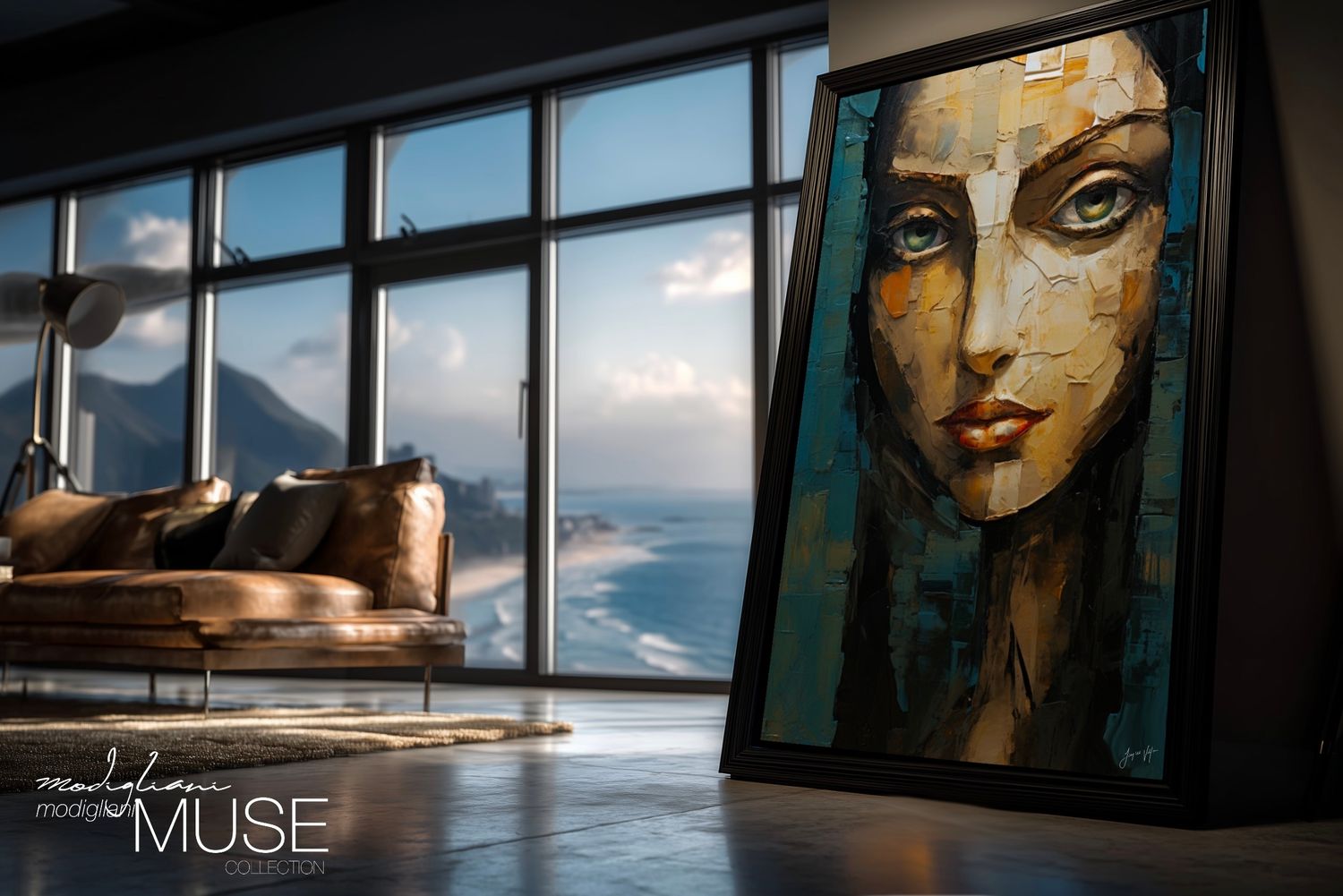
The face is close, frontal, and fractured into hundreds of overlapping impasto fragments, each one a small plane of cream, parchment, warm ochre, or pale gold, pressed and layered until the skin reads as something excavated rather than applied. The surface texture is extraordinary, thick ridges and torn edges catching light across the face the way old walls catch it, unevenly, with character. Her eyes are the stillest point in all that physical complexity: green-grey, heavy-lidded, and completely steady. A dark headscarf or hair sits tight against the skull, framing the face without softening it. The background is a deep, worn teal with blocks of near-black, shifting and layered, pushing the warm gold of the face forward. At the crown, a fragment of raw gold catches the light like a seam of ore in stone.
THE INSPIRATION
This piece began with the question of what a face looks like when it has been put back together rather than simply painted. The impasto technique was pushed here to its logical conclusion, not as texture for its own sake but as a structural language, each fragment a piece of experience pressed back into place. The green eyes arrived as the element that refused to be fragmented. Whatever else was broken and reassembled, the gaze remained whole. That contrast, a face made of pieces holding a look of complete composure, became the emotional core of the entire work.
WHAT IT CARRIES
Rivona carries the particular authority of someone who has been taken apart by circumstance and returned to themselves without apology. The fractured surface is not damage. It is record. Each impasto plane holds its position in the overall face the way memory holds its position in the overall self: imperfectly, insistently, and with full weight. The green eyes cut through the surface complexity without effort. That is the piece's central truth: however fragmented the surface, the gaze is the one thing that was never lost. This is the painting for the wall of someone who knows what that feels like.
LIVING WITH IT
The palette of deep teal, warm gold, parchment cream, and near-black gives this piece a richness that works across a wide range of interior conditions. In spaces with dark timber, aged brass, raw linen, or stone surfaces, the warmth of the face sits in immediate conversation with the materials. In lighter, more minimal spaces, the depth of the teal background anchors the room without heaviness. The physical texture of the impasto means the piece reads differently under natural and artificial light, picking up warmth in the evening that the morning light replaces with cooler clarity. This is a painting that never looks exactly the same twice. The A0 at 35mm profile is where the full surface detail becomes genuinely immersive.
WHO IT'S FOR
This is for the person who has lived through something and come out the other side still looking forward. It is also for the designer who understands that a room with a painting this specific will never feel generic, regardless of what surrounds it.
A NOTE ON SIZES
This design is available in a range of sizes to suit your space. Available as A0 and A1 poster prints, rolled and shipped. Also available as mounted canvas prints in 16mm, 25mm, 35mm, and 50mm profile thicknesses in both A0 and A1. A large format 1200 x 2000mm option is available on both poster and mounted canvas. Email jacques@jacquesviljoen.co.za for a quote and full details. Please note that proportions shown in previews are for display purposes only. Your final print dimensions will depend on the size you select.
The most popular size across our canvas range is the A0 in a 35mm profile frame.
You May Also Like
Display prices in:ZAR