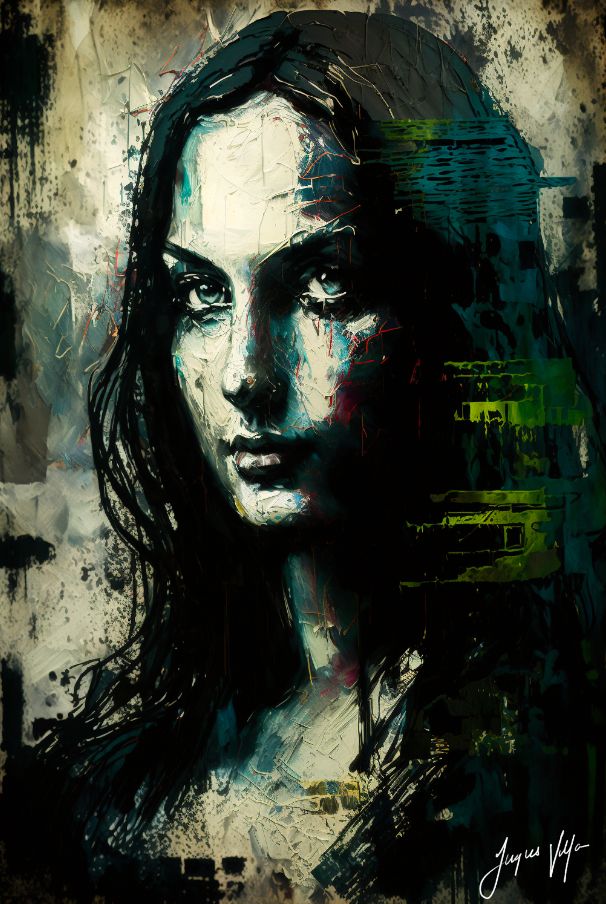
Mona Lisa 2nd, Noir Art Canvas Print
SKU C-ML001
R1 999.00
Canvas Size
Frame Thickness
Please choose
Written in Ink and Reckoning
1
Save this product for later
Have questions?
Mona Lisa 2nd, Noir Art Canvas Print
Product Details
The Work
The face arrives in near-white against deep shadow, starkly lit from the front in a way that flattens warmth and replaces it with forensic clarity. Thin red scratch lines run across the forehead and cheeks like hairline fractures in a surface under pressure, the only warm colour in an otherwise cold composition. Teal and slate-blue wash across the skin in the shadows, giving the face a bruised, nocturnal quality that has nothing to do with damage and everything to do with the hour. Heavy black impasto-style strokes build the hair and dissolve into the surrounding dark, their edges ragged and uncontained. The background is layered and weathered, aged parchment textures interrupted by a column of acid olive green and teal on the right, blocky and graphic, reading like exposed urban infrastructure behind a torn surface. Black splatters and drip marks punctuate the lower portions of the composition. The eyes are the coldest thing in the piece, pale, direct, and entirely without concession.
The Inspiration
Noir as a visual language was never really about darkness. It was about what light reveals when it has no interest in flattering its subject. The high-contrast, cold-toned approach here strips the most studied face in Western art of every layer of mystique that five centuries of reverence applied to it, and replaces all of it with something more confrontational: a woman seen clearly, in bad light, with nowhere to hide and no apparent desire to. The urban surface elements on the right are not decoration. They place her outside the gallery and on the street.
What It Carries
Those eyes do not invite interpretation. They end it. Every other piece in the Mona Lisa collection offers the viewer some form of negotiation, warmth, colour, atmospheric distance, or psychological ambiguity. This one offers none of that. The reckoning in the title is not metaphorical. It is the experience of standing in front of a face that has decided it is done being read and has started reading back. That reversal is what the piece is built around, and it is what stays long after you have left the room.
Living With It
The palette of near-black, cold white, teal, and acid olive green is specific and uncompromising. It belongs in interiors that share those qualities: dark industrial spaces, concrete and steel environments, monochrome or near-monochrome rooms where the acid green accent in the piece becomes the only colour event in the space. It works in a collector's study, a design-forward hotel room built around darkness rather than warmth, a creative studio, or a gallery-style hallway where the piece can be encountered head-on at close range. This is not background art. It requires a wall to itself and enough space for the viewer to feel the full weight of that gaze from a distance before they get close enough to see the detail.
Who It's For
For someone who has no interest in art that reassures them, and who understands that the most powerful portraits are the ones that refuse to be charming.
A Note on Sizes
This design is available in a range of sizes to suit your space. Available as A0 and A1 poster prints, rolled and shipped. Also available as mounted art prints in 16mm, 25mm, 35mm, and 50mm profile thicknesses in both A0 and A1. A large format 1200 x 2000mm option is available on both poster and mounted. Floating frames are available on request. Email jacques@jacquesviljoen.co.za for a quote and full details. Please note that proportions, decor, and frames shown in previews are for display purposes only. Your final print dimensions will depend on the size you select.
The most popular size across our canvas range is the A0 in a 35mm profile frame.
You May Also Like
Display prices in:ZAR