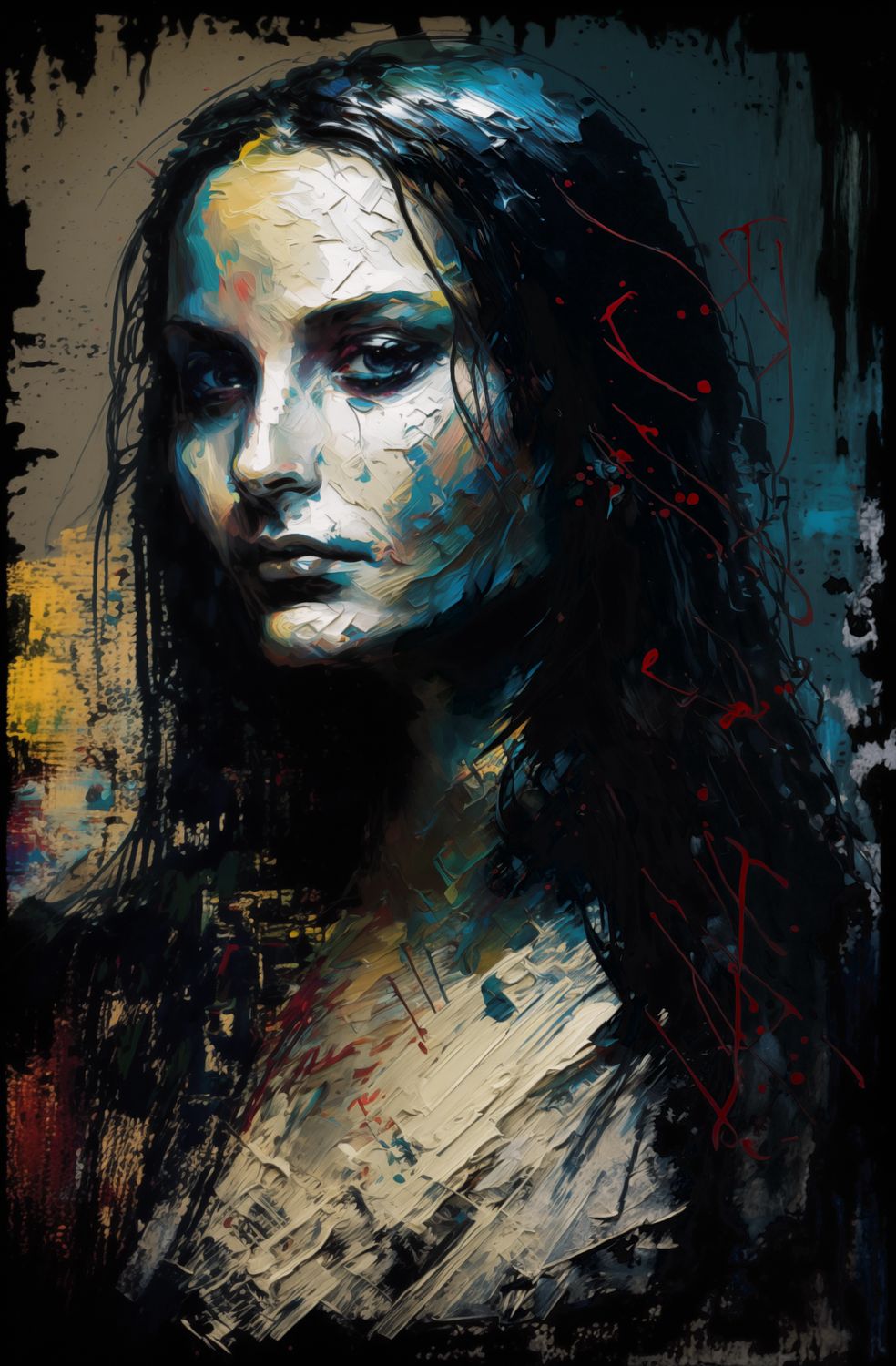
Mona Lisa, Sovereign of the Shattered Hour Art Canvas Print
SKU C-ML012
R1 999.00
All Time Best Seller
Canvas Size
Frame Thickness
Please choose
The World Bent. She Did Not.
1
Save this product for later
Have questions?
Mona Lisa, Sovereign of the Shattered Hour Art Canvas Print
Product Details
The Work
The face emerges from deep shadow with the kind of presence that does not ask for attention; it simply commands it. Impasto-style planes of cold white and pale teal build the skin in layered, fractured segments, each catching light at a different angle, the surface reading like something that has been tested and held. Warm ochre and soft gold surface on the left side of the face and background, the only concession to warmth in an otherwise cold and unforgiving composition. The background is raw and confrontational: heavy black borders frame the edges like a vignette burned into the surface, while teal, yellow ochre, deep red, and near-black collide in loose, aggressive impasto-style marks behind the figure. Red splatter lines erupt across the right side of the composition, sharp and deliberate, cutting through the teal like something that could not be contained. The hair falls in deep blue-black waves, dissolving at the edges into the surrounding dark. Her gaze is directed downward and inward, not in defeat but in the way of someone who has already decided and is simply waiting for the world to catch up. The chest and shoulders are built from layered white and grey impasto-style strokes, substantial and grounded, the base from which everything above rises.
The Inspiration
Every collection has a piece that the others orbit. This is that piece. Where the rest of the Mona Lisa collection explores duality, colour, transformation, and atmosphere, this one explores what is left when all of those things have been stripped away. What remains is not the icon, not the smile, not the five centuries of accumulated meaning. What remains is the woman, undecorated and uncompromising, rendered in the most direct visual language available: cold light, raw surface, and the total absence of any desire to be understood on anyone else's terms.
What It Carries
The red splatter lines are the detail that stays. Everything else in the composition is controlled, weighted, deliberate. Those red marks are the only thing that reads as rupture, and yet the figure beneath them is completely unmoved. That is the entire emotional argument of the piece. The world breaks things around her. She registers it. She does not absorb it. That distinction, between witnessing and being defined by what you witness, is the quality that makes this the flagship of the collection rather than simply its darkest piece.
Living With It
The palette of cold white, deep teal, raw black, yellow ochre, and red demands an interior that can hold authority. Dark feature walls in charcoal, midnight navy, or deep forest green give the piece the contrast it needs to fully separate from the surface. In lighter rooms, it operates as an absolute focal point, pulling the entire spatial register into its orbit. This is a piece for the principal room of a space, the wall that is seen first and remembered last. A collector's centrepiece, a hotel lobby anchor, the statement wall of a private residence designed around one image strong enough to carry the rest. The large format 1200 x 2000mm option is the natural choice for this piece. Scale is not excessive here. It is accuracy.
Who It's For
For someone who has been through the kind of things that change a person and come out the other side still entirely themselves. They will know this piece the moment they see it.
A Note on Sizes
This design is available in a range of sizes to suit your space. Available as A0 and A1 poster prints, rolled and shipped. Also available as mounted art prints in 16mm, 25mm, 35mm, and 50mm profile thicknesses in both A0 and A1. A large format 1200 x 2000mm option is available on both poster and mounted. Floating frames are available on request. Email jacques@jacquesviljoen.co.za for a quote and full details. Please note that proportions, decor, and frames shown in previews are for display purposes only. Your final print dimensions will depend on the size you select.
The most popular size across our canvas range is the A0 in a 35mm profile frame.
You May Also Like
Display prices in:ZAR